
Industry News 61
Why Agricultural Innovation Scales in Some Regions—and Stalls in Others
INTRODUCTION
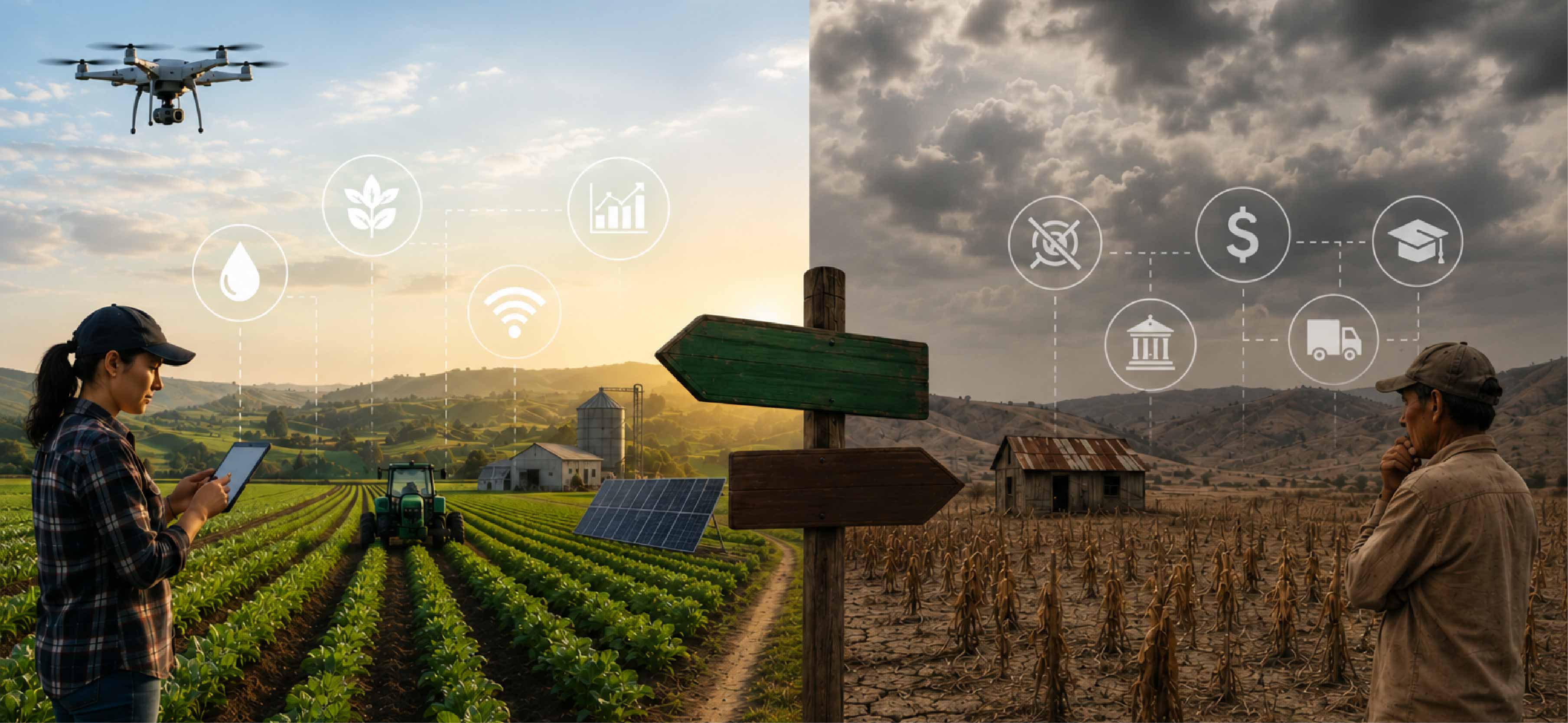
Yet despite this acceleration, the global distribution of impact remains uneven.
In certain regions, agricultural innovations transition rapidly from research environments to large-scale implementation. In others, equally promising technologies struggle to move beyond pilot phases or isolated deployments.
This disparity raises an increasingly important question:
Why does agricultural innovation scale effectively in some systems while stagnating in others?
The answer lies not only in the quality of innovation itself, but in the broader systems that determine whether innovation can move, integrate, and sustain impact at scale.
BEYOND TECHNOLOGY: UNDERSTANDING ECOSYSTEM READINESS
Discussions surrounding agricultural transformation frequently emphasize technological advancement. However, technological availability alone rarely determines adoption outcomes.
Innovations scale when supported by enabling ecosystems that align:
-
Infrastructure
-
Policy frameworks
-
Institutional coordination
-
Financing mechanisms
-
Knowledge accessibility
Without these interconnected components, even highly advanced solutions encounter barriers to implementation.
This shifts the conversation from innovation capacity to ecosystem readiness.
INFRASTRUCTURE AS A FOUNDATIONAL ENABLER
Infrastructure remains one of the most significant determinants of agricultural innovation scalability.
This includes not only physical infrastructure—such as irrigation systems, logistics networks, storage facilities, and digital connectivity—but also institutional infrastructure capable of supporting implementation.
Regions with stronger infrastructure ecosystems are often better positioned to:
-
Integrate digital agriculture technologies
-
Support real-time data systems
-
Facilitate market access
-
Reduce implementation costs
Conversely, where infrastructure gaps persist, innovation adoption becomes fragmented and inconsistent.
In many contexts, the limiting factor is not whether innovation exists, but whether systems are capable of operationalizing it effectively.
THE ROLE OF POLICY ALIGNMENT
Policy frameworks play a critical role in shaping innovation trajectories.
Supportive policy environments can accelerate adoption through:
-
Regulatory clarity
-
Research incentives
-
Investment support
-
Public-private collaboration mechanisms
However, policy fragmentation often slows implementation.
In some regions, agricultural policies continue to operate independently from broader priorities related to climate adaptation, public health, digital transformation, and sustainability. This disconnect reduces the ability of systems to integrate innovation cohesively.
Scalable transformation requires policy structures that are adaptive, coordinated, and aligned with long-term system objectives.
RESEARCH ACCESSIBILITY AND KNOWLEDGE TRANSLATION
A substantial volume of agricultural research remains concentrated within academic and institutional ecosystems.
While scientific advancement continues to expand, translation into practical implementation pathways is frequently limited.
Key challenges include:
-
Technical complexity of research outputs
-
Limited accessibility for practitioners and policymakers
-
Weak interfaces between research institutions and implementation systems
As a result, innovations often demonstrate strong theoretical potential while encountering barriers in real-world application environments.
This highlights the importance of knowledge translation mechanisms capable of bridging research, policy, and practice.
INSTITUTIONAL COORDINATION AND SYSTEM INTEGRATION
Innovation scaling depends heavily on the ability of institutions to operate collaboratively across sectors.
Agriculture today intersects with:
-
Climate systems
-
Public health systems
-
Digital infrastructure ecosystems
-
Environmental governance frameworks
However, institutional structures often remain fragmented, resulting in duplicated efforts, inconsistent implementation pathways, and delayed adoption cycles.
Regions that scale innovation more effectively typically demonstrate stronger alignment between:
-
Research institutions
-
Governments
-
Industry stakeholders
-
Extension systems
-
Funding ecosystems
This coordination creates continuity across the innovation pipeline.
FROM INNOVATION TO IMPLEMENTATION
The assumption that innovation alone drives transformation oversimplifies the realities of agricultural systems.
The true challenge lies in implementation architecture.
Successful systems are not necessarily those generating the highest volume of innovation, but those capable of:
-
Translating research into practical solutions
-
Creating supportive policy conditions
-
Building implementation capacity
-
Sustaining adoption through institutional support
In this context, scalability becomes a systems outcome rather than a technological outcome.
IMPLICATIONS FOR GLOBAL AGRICULTURAL SYSTEMS
As agriculture confronts increasingly interconnected pressures—including climate instability, food security concerns, and resource constraints—the ability to scale innovation effectively will become increasingly critical.
The future of agricultural transformation will depend less on isolated breakthroughs and more on the strength of the ecosystems surrounding them.
This requires a shift in perspective:
From viewing innovation as a standalone achievement
to understanding innovation as part of a broader systems process
CONCLUSION
Agricultural innovation does not succeed or fail in isolation.
Its trajectory is shaped by infrastructure readiness, institutional coordination, policy alignment, and the ability of systems to translate knowledge into action.
As global agricultural systems continue to evolve, the central challenge is no longer whether innovation can be developed.
It is whether systems are prepared to carry that innovation forward—consistently, inclusively, and at scale.
FAQs
Because scalability depends on ecosystem readiness, including infrastructure, policy alignment, institutional coordination, and implementation capacity.




